


- Home /
- Preventive Dentistry /
- Oral ID Screening
Oral ID Screening
Why Oral Cancer Screening Matters
Around the world, oral cancer is diagnosed in roughly 1 person every hour. When caught early (Stage1), the 5-year survival rate exceeds 80%. When caught late (Stage 3–4), survival drops to around 30–40%.
The challenge is that early oral cancer rarely hurts and often doesn’t look alarming. It can hide on the tongue, the floor of the mouth, the inside of the cheeks or the back of the throat — places you can’t easily inspect yourself. That’s where a professional screening makes the difference.
What Is Oral ID?
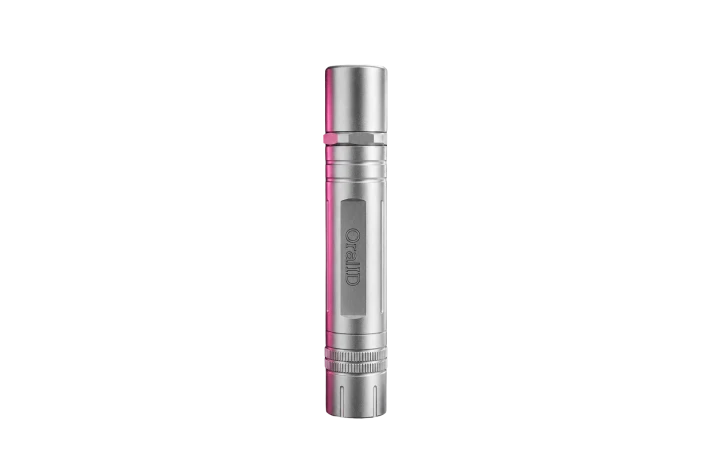
Oral ID is a fluorescence screening device that uses a specific wavelength of blue light (around 405nm) to illuminate the soft tissues of the mouth. Healthy tissue naturally fluoresces green under this light. Abnormal tissue — including dysplasia and early-stage cancer — appears dark, indicating loss of fluorescence. In essence, Oral ID helps us see what the naked eye cannot — making it possible to identify lesions that would otherwise be missed during a standard visual examination.
- Modern scaling at Dentistar includes:
- Ultrasonic scaling — gentle vibrations break down tartar above and below the gum line
- Hand-instrument finishing — for areas the ultrasonic can't reach
- Air polishing — removes surface stains from coffee, tea, wine and smoking
- Professional polishing — leaves teeth smooth, so plaque has fewer places to attach
- Fluoride application — strengthens enamel after cleaning
Who Should Be Screened?
- All adults benefit from annual screening, but it's especially important if you:
- Are over 40 years old
- Smoke or use tobacco (including e-cigarettes and shisha)
- Drink alcohol regularly (especially combined with smoking — risk multiplies)
- Have a family history of head and neck cancers
- Have HPV (human papillomavirus)
- Have had previous oral lesions, leukoplakia or erythroplakia
- Spend significant time in the sun (lip cancer risk)
- Have a weakened immune system
The Procedure Step by Step
Visual & manual examination:
We carefully inspect every soft tissue surface in your mouth — tongue (all surfaces), floor of the mouth, palate, cheeks, lips, gums and the back of the throat — and gently palpate the neck and jaw lymph nodes
Oral ID fluorescence screening:
We dim the room lights and use the Oral ID handheld device, scanning every soft tissue area. The blue light reveals healthy tissue as bright green and any suspicious area as a dark spot — giving us a clear visual contrast.
Documentation
If any abnormality is detected, we photograph it, document its location and size, and discuss next steps with you.
Follow-up planning
Many findings are benign (a bite mark, a small irritation, an ulcer). We typically re-examine in 2 weeks. If a lesion persists or appears suspicious, we refer you for a biopsy to specialist colleagues — without delay.
Warning Signs to Watch For
- Contact us promptly if you notice any of the following — especially if they persist for more than 2 weeks:
- A sore in the mouth that doesn't heal
- A white or red patch on the tongue, gums or inside of the cheek
- A lump or thickening in the cheek, tongue or neck
- Difficulty chewing, swallowing or moving the jaw or tongue
- Numbness in the tongue or other parts of the mouth
- Persistent ear pain (when there's no ear infection)
- Loose teeth or dentures that suddenly fit poorly
- A persistent sore throat or hoarseness
Benefits of Adding Oral ID to Your Check-up
- Detection of pre-cancerous and early-stage cancerous lesions before they become visible
- Painless, radiation-free screening — takes 2–3 minutes
- Peace of mind for high-risk patients
- Allows earliest possible referral and treatment, dramatically improving outcomes
- Documents a baseline image of your oral tissues for future comparison
Everything You Need to Know
Frequently Asked Questions (FAQ)
Does the Oral ID screening hurt?
Not at all. It’s a completely painless, non-invasive screening that uses only a beam of blue light. There’s no radiation, no contact, no discomfort — and the entire screening takes about 2–3 minutes.
How often should I be screened?
We recommend an annual screening for all adults aged 18 and over. For higher-risk patients (smokers, regular drinkers, those over 40, or with a previous lesion), we recommend screening every6 months.
Does Oral ID diagnose cancer?
No — Oral ID is a screening tool, not a diagnostic one. It helps us identify areas that warrant closer examination. A definitive diagnosis of oral cancer or precancer can only be made through a biopsy(tissue sampling), performed by a specialist.
What if you find something suspicious?
Most findings turn out to be benign — a bite mark, a healing ulcer, an irritation from a sharp tooth or filling. We typically photograph the lesion, document its size, and re-examine in 2 weeks. If anything persists or appears concerning, we refer you immediately to a specialist for biopsy. We always involve you in every step.
Is this screening covered by insurance?
Some insurance plans cover oral cancer screening, especially for high-risk patients. We provide detailed receipts for reimbursement claims. Even if not covered, the cost is modest compared to the potential benefit.
Can I screen for oral cancer at home?
You can — and should — perform monthly self-examinations of your mouth (we’ll teach you how).However, you can’t replicate fluorescence screening at home, and many lesions are in areas hard to see yourself. Self-checks complement, but don’t replace, a professional screening.
Ready to Book Your Appointment?
Contact us today to schedule your visit and take the first step toward a healthier smile.