


- Home /
- Dental Xrays
Dental Xrays at Dentistar
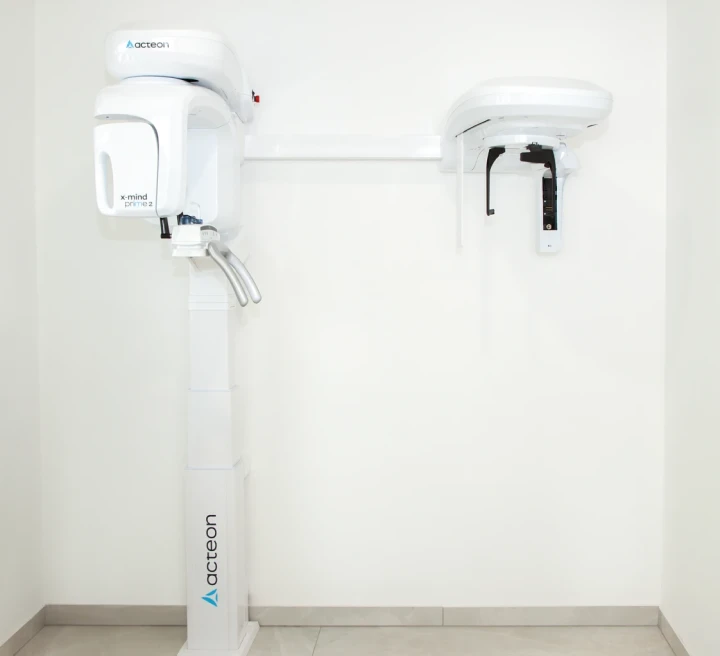
Dental X-rays are the dentist’s “eyes” where clinical examination cannot reach. At Dentistar Dental Clinic in Strovolos, Nicosia, we offer all modern digital X-ray technologies with low radiation doses —from small periapical X-rays to panoramic and cephalometric imaging. Digital radiation is up to 90% lower than older analogue techniques, and results are immediately available on screen — no waiting.
The panoramic X-ray is a wide image that shows the entire mouth in a single picture: upper and lower jaws, all teeth, the temporomandibular joints and the sinuses.
The cephalometric X-ray is a side image of the skull used primarily in orthodontic treatment and complex restoration planning.
The periapical X-ray is a small, targeted intraoral X-ray that shows the entire tooth — from crown to root tip — together with the surrounding bone.
What a Dental X-ray “Sees”
- Decay between teeth (not visible to the naked eye)
- Damage beneath existing fillings
- Root infections (abscesses)
- Gum disease and bone loss (periodontitis)
- Impacted teeth (wisdom teeth, canines)
- Cysts or tumours in the jaws
- Root fractures
- Tooth development in children
Types of Dental X-rays at Dentistar
- At Dentistar we use, digitally:
- Periapical X-rays — one or two teeth, for precise root examination — see details
- Bitewing X-rays — for detecting decay between back teeth — see details
- Panoramic — full mouth, jaws, joints — see details
- Cephalometric — skull profile for orthodontic planning — see details
- CBCT (3D) — 3-dimensional imaging for complex cases (implants, impacted wisdom teeth)
Are Dental X-rays Safe?
- Yes. Modern digital X-rays use extremely low radiation doses. For comparison:
- One digital periapical: ~0.005 mSv
- One digital panoramic: ~0.01–0.03 mSv
- One flight (Nicosia–London): ~0.04 mSv
- Background radiation (1 year): ~3 mSv
- In other words, a dental X-ray equals less than one day of background radiation from the environment.
Safety Measures at Dentistar
- Low-dose digital equipment
- Lead apron for all patients
- Thyroid collar where needed
- X-rays taken ONLY when clinically necessary
- Special protection for children and pregnant women (ALARA principle — as low as reasonably achievable)
How Often Are They Needed?
- Frequency is personalised for each patient. Generally:
- Adults with no decay history:
- Bitewings: every 18–36 months
- Panoramic: every 3–5 years
- Adults with a history of decay or periodontitis:
- Bitewings: every 6–12 months
- Periapical: as diagnostically required
- Children:
- First X-rays: usually 5–6 years old
- Frequency based on decay risk
- Before specific treatments:
- Implants: CBCT required
- Orthodontics: panoramic + cephalometric
- Root canal treatment: 2–4 periapicals before, during and after treatment
Pregnancy & X-rays
For pregnant women, we postpone all non-urgent X-rays, especially in the 1st trimester. In urgent cases (e.g. an abscess with pain), it’s performed with full protective apron and notification of your gynaecologist — the dose is safe, but we always apply the “if not needed, not done” principle.
Everything You Need to Know
Frequently Asked Questions (FAQ)
Why do I need X-rays if my teeth don't hurt?
Many dental problems (decay between teeth, root infection, bone loss) don’t cause symptoms in the early stages. X-rays catch them early — when treatment is still simple and affordable.
Is it safe for children?
Yes. With modern digital technology, the dose is minimal. We take additional protective measures (lead apron, thyroid collar) and only take X-rays when clinically necessary.
Can I refuse X-rays?
Of course, it’s your right. However, certain treatments (e.g. root canal, implants, orthodontics)cannot be safely performed without radiographic assessment. At Dentistar, we always explain what’s needed and why.
How long does an X-ray take?
The exposure itself: 0.1–0.5 seconds. The entire process (positioning, exposure, viewing): 1–5 minutes.
Can I bring X-rays from another dentist?
Yes, and we appreciate it — we avoid duplicate imaging. Send them digitally or bring them to the appointment. We take new ones only if the older ones don’t provide the information we need.
Do you give me a copy of my X-rays?
Yes, always. You receive digital copies via email or USB. They are part of your medical record and belong to you.
Ready to Book Your Appointment?
Contact us today to schedule your visit and take the first step toward a healthier smile.