


- Home /
- Paediatric Dentistry /
- Dental Anxiety Management
Dental Anxiety Management
Dental Anxiety Management for Children
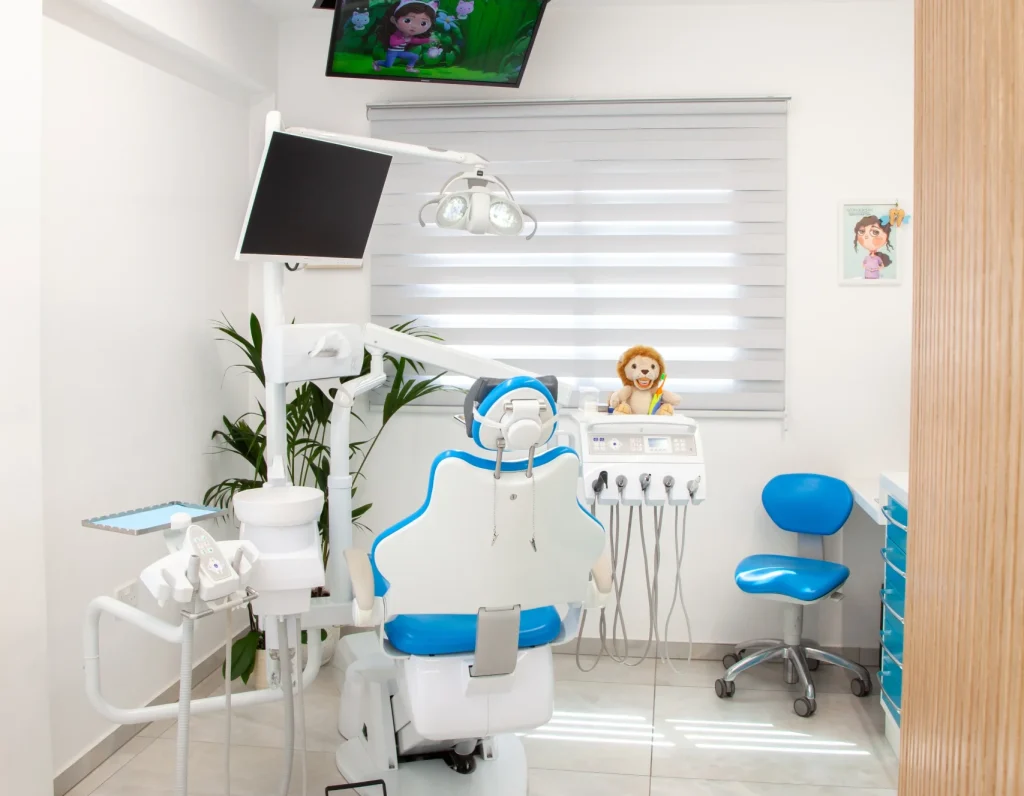
A fearful child can become a fearful adult — and adult dental anxiety often leads to decades of avoided care, lost teeth and serious health problems. At Dentistar Dental Clinic in Strovolos, Nicosia, we treat dental anxiety as seriously as we treat decay. Every part of our paediatric practice — from the waiting room to the techniques we use — is designed to help children feel calm, safe and in control.
Why Dental Anxiety Happens
- Children become anxious about the dentist for many reasons:
- Fear of the unknown (sounds, lights, instruments)
- A previous unpleasant experience
- Picking up a parent's or sibling's dental fear
- Being told scary stories by classmates
- Anxiety about not being in control
- Sensory sensitivities (sounds, smells, tastes)
- General anxiety or temperament
- None of these means a child "can't cope." They mean we need to slow down, build trust, and use the right techniques. Anxiety isn't a defect — it's information.
Our Core Techniques
- Tell–Show–Do:
- The gold standard of paediatric dental communication. Before doing anything:
- TELL: We explain what we're going to do, in simple, age-appropriate words
- SHOW: We demonstrate on the child's hand, finger or a toy
- DO: Only then do we proceed — with the child knowing exactly what to expect
- This eliminates the fear of the unknown and gives the child a sense of partnership in their care.
- Child-Friendly Language:
- Words shape how a child experiences treatment. We replace clinical terms with familiar, friendly ones:
- "Drill" → "tooth wash" or "toothbrush"
- "Injection" → "sleepy juice for the tooth"
- "X-ray" → "tooth photo"
- "Suction" → "thirsty straw"
- "Rubber dam" → "tooth raincoat"
- "Rubber dam" → " We also avoid "don't worry", "this won't hurt" and "be brave" — these phrases all signal there's something to fear. Instead we use "you might feel a buzz", "this is the easy bit" and "that was excellentraincoat"
- Positive Reinforcement:
- Praise specific behaviours, not vague "good child" comments:
- "You kept your mouth open beautifully — that was so helpful."
- "You took the deep breath when I asked. That helped me work faster."
- Small rewards at the end (sticker, small toy, certificate)
- Giving the Child Control:
- "Hand up" signal — if anything is uncomfortable, the child raises their hand and we stop
- Choices — "Which colour sticker?", "Cherry or strawberry varnish?", "Music on the headphones?"
- Breaks — pre-arranged pauses every few minutes during longer procedures
- Sensory & Comfort Adjustments:
- Soft music or the child's favourite song through headphones
- Videos on the ceiling during treatment
- Sunglasses to dim the overhead light
- Weighted blanket for children with sensory needs
- Bringing a favourite toy or blanket
- Cool, calm room temperature
Nitrous Oxide (Laughing Gas)
What It Is
Nitrous oxide is a safe, mild sedative gas that’s been used in paediatric dentistry for over a century. The child breathes it through a small nose mask. It produces a calm, slightly floaty feeling — without putting the child to sleep. The child remains awake, responsive and able to communicate the entire time.
Why It Works So Well for Anxious Children
- Takes effect within 2–3 minutes — and wears off completely within 5 minutes of stopping
- The child is fully awake — just relaxed and slightly distanced from anxiety
- Reduces gag reflex (very useful for sensitive children)
- Increases pain threshold (often less or no local anaesthetic needed)
- Completely reversible — no "hangover" effect
- Child can return to school the same day
Safety
Nitrous oxide has been used safely in millions of paediatric appointments worldwide. We use modern delivery systems with built-in oxygen monitoring, controlled flow rates, and clear safety protocols. The child is monitored throughout. Nitrous oxide is not recommended for children with certain respiratory conditions or recent ear infections — we always discuss the medical history thoroughly first.
When We Consider Nitrous Oxide
- Children with moderate-to-significant dental anxiety
- Longer or more involved procedures (multiple fillings, crowns, pulpotomy)
- Strong gag reflex
- Children with special needs where it makes treatment possible
- As a confidence-builder for the first "big" appointment
Conscious Sedation (Oral or IV) — In Special Cases
For some children — particularly very young children with extensive treatment needs, children with significant special needs, or those for whom nitrous oxide isn’t enough — deeper sedation may be needed. We coordinate this through specialist anaesthetist colleagues in a hospital or surgery setting, always with full safety monitoring. This is reserved for cases where it’s genuinely the right choice — never as a shortcut.
Tips for Parents Before the Appointment
- In the days before:
- Talk about the appointment casually and positively
- Read a children's book about the dentist
- Avoid words like "shot", "drill", "pain" or "don't worry"
- Don't share your own dental fears with your child
- On the day:
- Schedule for a well-rested, well-fed time (not nap time or right before a meal)
- Bring a comfort item — favourite toy, blanket, headphones
- Arrive a few minutes early so the child can settle
- Be calm yourself — your calm is contagious
- During the appointment:
- Let the dental team lead — too many adult voices can overwhelm
- Praise effort, not bravery ("You worked hard" rather than "You were brave")
- Be present but not anxious
- After the appointment:
- Celebrate the achievement
- Avoid making it sound like a survival ordeal
- Talk about what went well, even if there were tears
For Children with Special Needs
- We have experience caring for children with autism spectrum conditions, ADHD, sensory processing differences, Down syndrome, cerebral palsy and other special needs. Our adaptations include:
- Longer appointments with frequent breaks
- Pre-visits to familiarise the child with the clinic
- Visual schedules and social stories sent home in advance
- Sensory adjustments (lighting, sound, temperature)
- Coordination with parents on the child's communication style
- Where appropriate, sedation options
Everything You Need to Know
Frequently Asked Questions (FAQ)
My child is terrified of the dentist — where do we even start?
Start with a no-treatment introductory visit. We just walk around the clinic, meet the team, and let the child sit in the chair if they want. No procedures, no pressure. From there we build up slowly. Sometimes it takes 2–4 short visits before the child is ready for any real treatment — and that’s completely fine. The relationship matters more than the speed.
Is laughing gas (nitrous oxide) safe for children?
Yes — extremely safe. It’s been used in paediatric dentistry for over a century, with modern monitoring systems making it even safer. The child remains awake and responsive, the effects wear off in minutes, and there’s no “hangover.” We always discuss medical history first to confirm suitability.
Will my child remember the appointment after nitrous oxide?
Yes — they remember everything. Nitrous oxide reduces anxiety and discomfort but doesn’t cause amnesia. The child usually remembers it as a calm, even pleasant, experience.
Can I be in the room with my anxious child?
Yes — and we encourage it for younger or particularly anxious children. Your presence is reassuring. We do ask parents to let the dental team lead the conversation during treatment — too many adult voices can be overwhelming.
What if the appointment doesn't go well — should we just give up?
Never. A difficult appointment isn’t a failure — it’s information about what to adjust next time. Sometimes we just need more time, a different approach, or to start with nitrous oxide. Every “hard” child has eventually become a comfortable one in our experience.
Should I tell my child everything that will happen at the appointment in advance?
Tell them honestly and simply — but only what they need to know. Too much detail can create anticipatory anxiety. “We’re going to see the dentist. They’re going to look at your teeth and count them. They’ll show you the special toothbrush. It’ll be fun” is often enough. We’ll explain the rest in age-appropriate language during the appointment.
My older child suddenly developed dental fear — why?
Often it’s a specific trigger — a school story, a sibling’s experience, a previous bad memory, or general anxiety. We work to identify and address the specific trigger rather than treating “fear” in the abstract. Sometimes a single calm visit is enough to reset the pattern.
Ready to Book Your Appointment?
Contact us today to schedule your visit and take the first step toward a healthier smile.