


- Home /
- Paediatric Dentistry /
- First Visit
First Visit
When Should the First Visit Happen?
The American Academy of Paediatric Dentistry, the European Academy of Paediatric Dentistry andour own clinical experience all converge on the same answer:
By the 1st birthday — or within 6 months of the first tooth appearing, whichever comes first.
Yes — even when the child has only one or two teeth. The visit isn’t about treating teeth. It’s aboutthree things:
- Familiarising the child with the dental environment in a low-pressure way
- Checking that the teeth, gums and jaws are developing as expected
- Educating you, the parent, on what to do at home to prevent problems
What We DON'T Do at the First Visit
- Force the child to lie back if they're not ready
- Take X-rays unless absolutely necessary
- Use anything that vibrates, sprays water or makes loud noises
- Rush
- Promise anything we can't deliver ("this won't take long" can backfire)
If your child isn’t ready for a full examination on the first visit, that’s completely fine. Sometimes the entire first appointment is just looking around and chatting — and we’ll do the actual look in the next visit. The relationship matters more than the speed.
What Happens at the First Visit
The first appointment is short (typically 20–30 minutes) and intentionally low-key. Here’s what to expect:
Welcome & exploration:
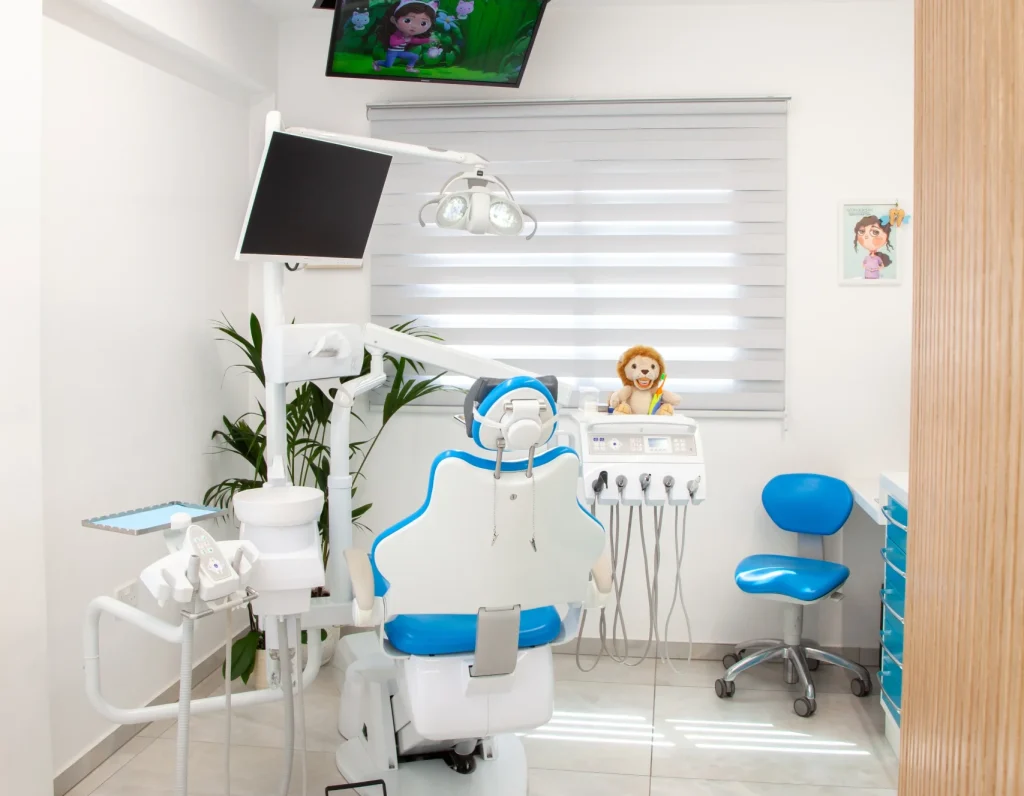
Your child gets to look around, sit in the chair if they want, and meet the dental team. We let them touch the (safe) instruments — the mirror, the air syringe — and get comfortable with the sounds and lights.
A gentle look-see:
Often done with the child sitting on the parent's lap ("knee-to-knee" examination). We have a quick look at the teeth, gums, lips, tongue and jaw development. Painless, takes 1–2 minutes.
Brushing demonstration:
We show you and your child how to brush age-appropriately. We might apply a small amount of fluoride varnish if the child cooperates and it's needed.
Parent discussion:
The most important part. We discuss diet, fluoride needs, brushing technique, pacifier or bottle habits, and answer all your questions. No question is too small.
A small reward & a happy goodbye:
A sticker, a small toy or a friendly high-five — so the child leaves with a positive memory.
Why the 1st Birthday Visit Is So Important
- Catches early decay ("bottle decay" and "early childhood caries") before it becomes painful
- Spots issues with tongue ties, lip ties or unusual tooth development
- Establishes a paediatric dental home — a clinic the family trusts and returns to
- Cuts the chance of dental anxiety in adulthood by half (research shows this clearly)
- Educates parents on the most preventable disease in children — dental decay
- Saves significant time, money and pain in the long run
How to Prepare Your Child at Home
Talk about it casually and positively:
“We’re going to see Dr X — they’re really friendly and they’ll just look at your teeth.” Avoid words like “shot”, “hurt”, “drill” or even “don’t worry” — these all signal there’s something to fear.
Read a children’s book about the dentist:
There are wonderful picture books that frame the dental visit as a fun adventure. We can recommend titles.
Practise at home:
Play “dentist” — count their teeth with a clean finger, let them brush a doll’s teeth, look in the mirror together.
Pick a good time:
Schedule the appointment when your child is normally rested and well-fed — not at nap time or right before a meal.
Bring comfort:
A favourite toy, blanket or pacifier is welcome. Whatever helps.
Stay calm yourself:
Children pick up parental anxiety instantly. If you’re calm, they’ll be calm. If you have your own dental fears, mention it to us — we’ll work around it.
After the First Visit
We typically recommend a follow-up every 6 months from then on — sometimes every 3–4 months in children at higher risk of decay (frequent snacking, special dietary needs, or those wearing appliances). At each visit we monitor development, reinforce hygiene, apply fluoride if indicated, and watch for early problems.
Everything You Need to Know
Frequently Asked Questions (FAQ)
Isn't a 1-year-old too young to go to the dentist?
Not at all — the first birthday is actually the ideal time. The visit isn’t about treatment; it’s about familiarisation, early decay prevention, and parent education. Many families are surprised at how quick and pleasant it is.
My child cries the whole time — what should I do?
It’s completely normal and we’re used to it. Some children cry the first time; many warm up by visit 2 or 3. We never force a procedure on a crying child unless it’s an emergency. Often we just do what we can comfortably, then build up gradually over future visits.
What if my child won't open their mouth?
That’s fine. We use playful tricks (“can you show me your teeth?”, “let’s count them together”) and never use force. If today they only want to sit in the chair, that’s still progress. Some children take 2–3 visits before they’re comfortable being examined — and that’s perfectly normal.
Do you take X-rays at the first visit?
Almost never — only if there’s a specific concern (like a visible cavity or trauma). Routine X-rays in young children are reserved for ages 4–6 onwards, and only when there’s a clinical reason.
Can I be in the room with my child?
Absolutely — and we encourage it for younger children. Your presence is reassuring. For older children (typically 6+), sometimes they cope better alone; we’ll figure out together what’s best.
How often should we come back after the first visit?
Every 6 months for routine check-ups. For children at higher decay risk (or wearing braces, space maintainers or habit appliances), we may suggest every 3–4 months.
How much does the first visit cost?
Costs are modest for a first visit because it’s primarily an examination and consultation. We provide a clear quote upfront. Many insurance providers cover paediatric preventive care fully — we provide all paperwork needed.
Ready to Book Your Appointment?
Contact us today to schedule your visit and take the first step toward a healthier smile.